
Electricity reaches your property through a connected chain of infrastructure, but most of it is easy to overlook until something needs repairing, replacing or upgrading.
In a typical Sydney property, electricity travels from the local Ausgrid or Endeavour Energy distribution network through a service line towards the property’s electrical installation. Depending on the supply arrangement, it may also pass through a private power pole before reaching the connection and attachment arrangement at the property. From there, the supply continues through consumer mains, metering and service equipment to the main switchboard, before being distributed through the property’s final electrical circuits.
Understanding what each stage does makes it much easier to understand electrical defects, supply upgrades and why some work requires specialist Level 2 ASP involvement.
If you have arrived here because something has already gone wrong, our guide to 10 situations where your Sydney property may need a Level 2 electrician covers the practical situations that can trigger Level 2 work.
At Level 2 Electrician Sydney, our team works across the Ausgrid and Endeavour Energy network areas on specialist Level 2 ASP projects as well as the general electrical work that can sit alongside them. That means we regularly work across multiple parts of this supply pathway rather than viewing each component in isolation.
And if you want to understand how the different ASP authorisations fit into this system, our upcoming guide to Level 2A, 2B, 2C and 2D accreditation in NSW explains the different classes and the types of work they cover.
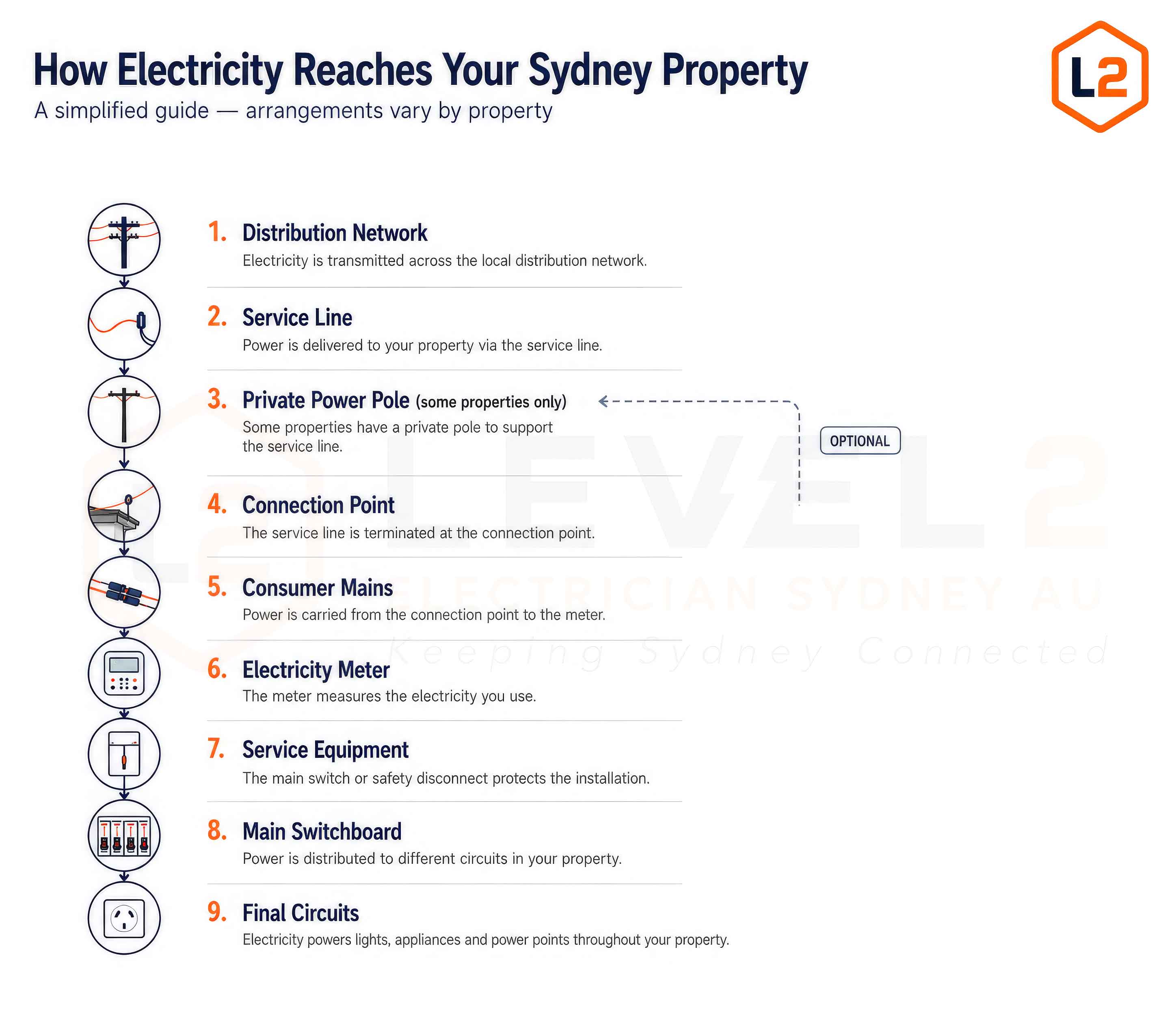
The easiest way to understand the system is to follow the electricity towards the building.
A typical supply can be simplified as:
Distribution Network → Service Line → Private Power Pole (some properties only) → Connection Point / Point of Attachment → Consumer Mains → Meter → Service Equipment → Main Switchboard → Final Circuits
This is a useful guide rather than a universal diagram. The exact physical arrangement and order of some components can vary depending on whether the property has an overhead or underground supply, a private pole, the location of the connection point and metering equipment, and the way the original connection was designed.
Let’s follow each stage.
The journey begins with the electricity distribution network.
Across most of Sydney, this is operated by either Ausgrid or Endeavour Energy. Their networks include infrastructure such as substations, transformers, street poles, overhead conductors, underground cables, pits, pillars and other equipment used to distribute electricity through local suburbs.
This is different from your electricity retailer.
Your retailer is the company that sells electricity to you and sends your electricity bill. The distribution network service provider, or DNSP, operates the physical network that delivers electricity through your area.
For many properties, the first part of this network that is easy to recognise is a street power pole or underground distribution infrastructure near the property.
From there, electricity needs a way to reach the individual installation.
The next stage is the service line.
Its job is to carry electricity between the distribution network and the customer’s supply arrangement.
Depending on the location and property, the service may be:
The NSW Accredited Service Provider Scheme includes specialist Level 2 work involving the construction and alteration of service lines between the distribution system and customer connections.
That gives the service line an important role: it is the electrical link between the broader network serving the neighbourhood and the individual property.
On an established Sydney street, this might be the cable you can see travelling from a network pole towards a house.
On another property, the equivalent service may disappear underground and be almost invisible from the street.
Not every Sydney property has a private power pole.
Many homes receive their incoming supply directly from network infrastructure towards the building, while others have a private pole forming an additional stage along the route.
Private poles are more likely to appear where:
Where one is installed, the incoming service may reach or pass through the private-pole arrangement before the supply continues towards the building.
For example, a simplified pathway might look like:
Network → Overhead Service → Private Power Pole → Building Connection / Point of Attachment → Consumer Mains
Depending on the installation, the supply leaving the private pole may continue towards the building overhead or underground.
A private pole therefore isn’t a mandatory third stage for every property. It is better thought of as an additional link in the supply pathway where the property’s particular connection arrangement requires one.
Another important distinction is that a pole being physically located on private land does not, by itself, prove it is privately owned. Network infrastructure can also exist on private land, including within easements.
Where ownership or responsibility is unclear, the actual asset and supply arrangement should be identified rather than assumed from its location.
As the incoming supply reaches the customer’s electrical installation, an important concept is the connection point.
This identifies the interface between the electricity distribution system and the customer’s electrical installation.
The precise physical location varies with the supply arrangement.
On some private-pole installations, the formal connection point may be associated with the pole itself rather than the building, so it should not be assumed that every property has exactly the same physical sequence or responsibility boundary.
For a property owner, the important point is that there is an identified interface between the distributor’s supply and the electrical installation serving the property.
That is also why the front boundary fence should not be treated as an automatic electrical responsibility line.
The actual connection arrangement needs to be established.
Where Does the Point of Attachment Fit?
For overhead supplies, another term you will commonly hear is the point of attachment.
The point of attachment describes where the mechanical load of an overhead service or overhead consumer mains is physically supported or terminated on a building, pole or other approved structure.
On a typical house, this might be the bracket or attachment arrangement you can see near the roofline.
Importantly, point of attachment and connection point are not simply interchangeable names for the same thing in every installation.
They describe different aspects of the supply arrangement and, depending on the configuration, may not represent exactly the same physical location.
This distinction becomes particularly relevant during:
After the applicable connection point, consumer mains carry electricity through the customer’s electrical installation towards the main switchboard.
They are a critical part of the supply pathway.
Depending on the property, consumer mains may be:
Consumer mains are quite different from the smaller final circuits supplying individual lights, power points or appliances.
They carry the incoming electrical supply for the property and therefore need to be suitable for the installation and its electrical demand.
This can become particularly important in older Sydney homes.
A property that was originally designed around relatively modest electrical loads may now contain large air conditioning systems, induction cooking, pool equipment, solar, batteries, EV charging and significantly more electrical equipment.
That does not automatically mean older consumer mains need replacing. But when a substantial supply or switchboard upgrade is being considered, their condition, capacity and existing arrangement may need to be assessed as part of the wider project.
As the incoming supply reaches the metering and switchboard area, the electricity meter performs a very specific job.
It measures the electricity consumed by the property.
Modern electricity meters can record usage in intervals and support remote communications and other functionality, but their basic purpose remains the same: measuring electrical energy consumption.
The meter is often installed in or around the main switchboard, which can make it appear to be simply another switchboard component.
It isn’t.
Metering operates within a separate regulatory and electricity-market framework involving retailers, metering coordinators and accredited providers.
For a property owner, the easiest distinction to remember is:
The meter measures the electricity you use. The switchboard controls and distributes that electricity throughout the property.
They may sit side by side, but they do very different jobs.
Also around the incoming supply and main switchboard area can be service equipment required as part of the electricity connection.
Its role can include controlling, protecting and securing aspects of the incoming electrical service.
Depending on the particular installation, this may include equipment such as service protection devices and other distributor-required equipment associated with the connection.
The Service and Installation Rules of NSW contain the detailed requirements applying to this equipment and customer connections.
This is another reason the physical appearance of a switchboard can be misleading.
An enclosure might contain ordinary customer electrical equipment alongside service-related equipment that is subject to different work and authorisation requirements.
Property owners do not need to identify those categories themselves. The electrician assessing the installation needs to recognise what equipment is present and what authority is required to work on it.
The main switchboard is the point most property owners recognise.
By the time electricity reaches it, the supply can be divided into the electrical circuits serving different parts of the property.
A modern switchboard can contain equipment such as:
The switchboard therefore performs two critical jobs:
distributing electricity to the circuits that need it, and providing electrical protection for the installation.
This is where the incoming supply effectively branches out into the individual electrical systems used throughout the home or commercial property.
However, a switchboard cannot always be considered independently from what feeds it.
A proposed switchboard upgrade may reveal deteriorated consumer mains, inadequate incoming capacity or another issue further upstream.
That is why major electrical upgrades often benefit from looking beyond the switchboard itself and back along the supply pathway.
Once electricity leaves the main switchboard, final subcircuits carry it to the equipment and outlets used throughout the property.
These circuits can supply:
At this end of the journey, we are largely dealing with conventional electrical installation work rather than the specialist network connection work associated with Level 2 ASP services.
So the complete journey has taken us from:
the neighbourhood electricity network → through the property’s incoming supply → into the switchboard → and finally out to the equipment you use every day.
The nine stages above explain the electrical functions, but they do not mean every Sydney property looks the same physically.
Two houses next door to one another can have noticeably different supply arrangements.
A relatively simple overhead arrangement might resemble:
Distribution Network → Overhead Service → Building Connection / Point of Attachment → Consumer Mains → Metering / Service Equipment → Main Switchboard
You may see the service cable arriving around the roofline and a point of attachment supporting the incoming conductors.
A larger or differently configured property might instead resemble:
Distribution Network → Overhead Service → Private Power Pole → Building Connection / Point of Attachment → Consumer Mains → Metering / Service Equipment → Main Switchboard
The supply leaving the private pole could continue towards the building either overhead or underground, depending on the installation.
Another property may receive electricity through underground infrastructure:
Distribution Network → Underground Service → Connection Arrangement → Consumer Mains → Metering / Service Equipment → Main Switchboard
Most of that journey may be completely hidden from view.
The underlying principle, however, remains the same: electricity moves from the distribution network through an established connection arrangement into the customer’s electrical installation and ultimately towards the switchboard.
Once the pathway itself makes sense, responsibility becomes easier to understand. As a broad guide:
Part of the Supply | What It Does | Typical Responsibility |
Distribution network | Carries electricity throughout the local area | Electricity distributor |
Service line | Carries electricity from the network towards the customer connection | Generally distributor network infrastructure |
Private power pole | Supports or carries private supply where installed | Generally property owner where genuinely private |
Connection point | Identifies the network/customer installation interface | Defines the applicable responsibility boundary |
Consumer mains | Carry the customer’s supply towards the switchboard | Customer electrical installation |
Electricity meter | Measures electricity consumption | Separate metering arrangements apply |
Service equipment | Helps control, protect and secure the incoming service | Responsibility/work requirements depend on the equipment |
Main switchboard | Distributes and protects electricity throughout the property | Customer electrical installation |
Final circuits | Deliver electricity to lights, outlets and equipment | Customer electrical installation |
This table is intentionally described as typical, because the exact arrangement matters.
For example, Ausgrid advises that property owners are responsible for applicable private electrical assets beyond its connection point, including private poles, private powerlines and associated fittings.
Different supply arrangements can place the connection point in different physical locations.
The important takeaway is therefore:
Do not determine electrical ownership simply by asking whether equipment is physically inside or outside the front boundary.
The actual connection arrangement establishes the relevant responsibility.
Level 2 ASP work generally becomes relevant around the specialised service and connection parts of this pathway rather than the final circuits throughout the property.
The NSW Accredited Service Provider Scheme includes Level 2 work involving service lines, new or altered connections and specified work associated with service equipment.
But there is an important qualification:
“Level 2” is not one blanket authorisation covering every type of service work.
Different work requires different accreditation and network authorisation.
We cover those accreditation categories separately in our dedicated guide to Level 2A, 2B, 2C and 2D in NSW, linked near the beginning of this article.
Individual workers also need the applicable network authorisation to perform the particular work involved.
The important point here is simply that Level 2 work can occur at several different places along the incoming supply pathway.
It is not confined to one particular cable, pole or box.
A recent project completed by our team in Sydney’s eastern suburbs provides a practical example of how these components connect.
The residential property was within the Ausgrid network area and required electrical work extending across several stages of its incoming supply.
On the consumer mains electrical upgrade in Eastern Sydney, Justin, one of our Level 2 ASP electricians, completed the electrical work with support from his apprentice Isaac.
The project included:
This is a useful real-world example because the job did not involve one isolated component.
The overhead service, consumer mains, metering and switchboard all formed parts of the same electrical supply pathway.
Looking only at the board would not have shown the complete project.
That is exactly why understanding how electricity reaches the property is useful when planning larger repairs and upgrades.
Electrical installations are systems.
Changing one significant part can affect what needs to be considered elsewhere.
For example, a major upgrade might reveal that:
This does not mean every switchboard upgrade or renovation becomes a complicated Level 2 project.
It means the scope should be determined from the actual electrical installation rather than from the name of the job alone.
This is particularly relevant to older Sydney properties, where several generations of electrical work may exist between the incoming connection and the current switchboard.
Electrical service connections in Sydney are governed by requirements beyond ordinary internal electrical wiring.
The Service and Installation Rules of NSW set out the industry requirements electricians and Accredited Service Providers must follow when connecting customers to NSW electricity distribution networks.
The current edition is the April 2026 Service and Installation Rules.
The Rules bring together common NSW distributor requirements while also allowing for network-specific methods and requirements.
That distinction matters because Sydney properties may sit within different electricity distribution areas.
Ausgrid and Endeavour Energy also maintain their own procedures, technical requirements and worker authorisation systems applying to work on their respective networks.
So while the general electricity journey is easy to illustrate, the exact connection arrangement and requirements should always be assessed for the individual property and network.
You do not need to identify the connection point, consumer mains or service equipment yourself before calling an electrician.
If you have a damaged electrical service, deteriorated consumer mains, a private pole problem, a defect notice or plans for a major electrical or switchboard upgrade, an inspection can establish where the issue sits within the supply pathway and what work is actually required.
Photos, defect notices, network correspondence and details of planned renovations or electrical upgrades can all help when discussing the project.
Level 2 Electrician Sydney works throughout the Ausgrid and Endeavour Energy network areas, providing specialist Level 2 ASP services alongside general residential and commercial electrical work.
Call 0468 088 764 to speak with our team about your property and the most practical way forward.
Whether you have an urgent 21-day defect notice to clear on a family home, need everyday enhancements like architectural lighting and rapid EV charger installations, or require high-capacity three-phase switchboard upgrades for a commercial business or strata portfolio, our team is ready to assist.
Contact Level 2 Electrician Sydney today to speak with our team about your property’s requirements.
Call 0468 088 764 now or request a callback here for a prompt follow up.